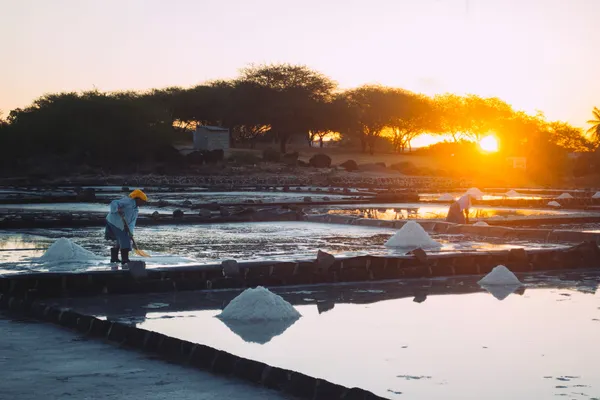
We’re feeling the brunt of water scarcity in Mauritius; it has made mundane domestic tasks stressful, and the intensity of that stress very much depends on your income. In bourgeois neighbourhoods that had historically never known visits from water bowsers, every gallon is now a calculation. Last week, water barely filled a quarter of a tank on the days when water was supposed to run through taps from 3-8am. This week, water hasn’t run from said taps at all. We can fathom – but only barely – the horror of having no tank, no proper running water, no sewage facilities and intermittent electricity, like 8.4% of the Mauritian population.
The recent protests have made Mauritians realise the depth of inequality across the country. We’re grateful to see the many conversations that have followed on repairing that inequality (scroll to read Lovebridge’s take below).

News digest
In our last Bulletin, we told you about the water protests occurring throughout the island. Two days later, on the night of 9 October, Élodie Thomas, a 27-year-old supermarket cashier on her way home from work, was shot in the neck by a police sergeant at Camp Levieux and wasn’t given any assistance by the sergeant or the other police officers present at the time. A surgical team flown in from India removed the bullet, and she is now recovering in hospital. Sergeant Gautam Singh Taukoor has been remanded until 26 October; three officers accused of leaving without helping her are out on bail.
Last week, Mauritius saw an explosion of protests and unrest, the intensity of which hadn’t been witnessed since 1999. The violence was directed at property, not people – no deaths have been reported. From 12 October, eight police stations were attacked, the Bambous court was set alight, 162 Safe City cameras were destroyed, a multitude of sugarcane fields were burnt and some supermarkets and shops were looted. A night-time curfew across 17 zones ran until 19 October; AFP counts at least 188 arrests, including at least sixteen minors. The government says drug barons are suspected of being behind the violence and of using children to carry it out, and police are investigating a WhatsApp group called ‘The Burning Paradise’, used to coordinate unrest. The state’s response has been swift: protesters are charged under the Prevention of Terrorism Act, and a Select Committee is examining a proposal to lower the age of criminal responsibility from 14 to 12 years old. There has been considerable outcry from human rights organisations following the state’s measures (and proposed measures) to prosecute and incarcerate children, and to charge protesters under the Prevention of Terrorism Act. Lovebridge, a non-profit dedicated to eradicating extreme poverty in Mauritius, has made an excellent argument that places poverty at the heart of the unrest (and offers solutions).
On the water scarcity front, Mare aux Vacoas was at 34.4% on 17 October, and parts of Plaines Wilhems now get water every other day, between 3am and 8am. These hours are the best case scenario – radio stations are inundated with complaints, with many people calling in to say they haven’t had running water in over a week. Some Mauritians are now washing their belongings in nearby rivers.
In related water news, the parliamentary session of 20 October was particularly instructive as to where we stand regarding our borehole supply. The Minister of Energy stated that the government drilled 24 boreholes last year, which brought 43,400 m3 of additional water to the national network. Joanna Bérenger asked the Minister if he could confirm whether Medine (the conglomerate) had effectively given the CWA six arpents of land and three boreholes to be used; the agreement, Bérenger said, hadn’t been signed even though it had been drafted in 2023. The Minister said that the Memorandum of Understanding between the conglomerate and the CWA hadn’t been signed, but that Medine should have drilled the boreholes and built the reservoir anyway.
Sydney Pierre has left the Labour Party and is in talks with the Fron Militan Progresis.
Kim Le Court-Pienaar crashed in the world championship road race and tore a quadriceps; though her international season is over – she’s aiming for the Ardennes Classics next spring – she was back on her bike during the CIEL Fundsmith Colin Mayer Tour this weekend.
And finally: corals are spawning around the east coast.

Diaspora spotlight

Teejana Beenessreesingh grew up in Beau Bassin and left Queen Elizabeth College for the Massachusetts Institute of Technology (MIT) on a full scholarship, graduating in Management Science and Economics in 2008. She began her career in investment banking at UBS in New York, moved to Citadel in 2010, and then left finance to found BeeJooS, a social enterprise selling the work of artisans from Mauritius, India, Vietnam and beyond directly to customers in America from 2011-2014. The next four years saw her return to the world of hedge fund investing. By early 2018, though, she was ready for a change: she took an MBA at HEC Paris, interned at Cartier, and joined Bain & Company in Dubai. In 2020 she moved to Milan as chief of staff to Bottega Veneta's CEO, Leo Rongone, and went on to direct the house's business development, retail performance and digital business. In July 2025, Kering appointed her the first chief executive of its jewellery brand DoDo. In 2026, she is building a brand of her own.
Teejana is the kind of person who will overhaul her life when she gets bored. Safety isn’t interesting to her. It’s a trait of character she’s had since she was a child; as an all-star student, she deliberately changed her answers during her CPE exam to see what would happen if she flunked parts of it. Fast-forward to 2018: at 33 years old, she left a coveted position as Vice President of an asset management firm in New York to pursue an MBA at HEC Paris (with a full scholarship). “I had savings but felt dead inside. I knew that asset management was something I could come back to, numbers come naturally to me, but I knew I didn’t want to sit behind a screen at 40 years old running the same credit programme.” During her MBA, she interned at Cartier, where her peers were a decade younger than her. By 2024, she had a powerhouse career directing retail, business development, retail performance and digital business at Bottega Veneta (yes, all at the same time); by 2025, she was CEO of the Italian jewellery brand DoDo, tasked with reimagining and repositioning the company; by September 2026, she left Kering to fly solo.
We can’t think of many people who would choose to start fresh this many times over, and who would make some of those career choices in times of immense global tumult. Her first day of work at UBS was also the day Lehman Brothers collapsed; while working for Bain, she was posted in Riyadh while the country was reforming major laws that allowed women to enter the workforce for the first time; she joined Bottega Veneta in Milan during the pandemic. She has an abundance of incredible stories, and behind each of them is a great sense of humour and a backbone of steel.
Teejana wanted to study in the United States because her classmates at QEC – some of whom were fiercely competitive – wanted to study in the UK. "I was very lucky. My parents took me to visit the U.S. when I was sixteen. I took the SAT (an exam that measured a student's knowledge and skill in specific academic subjects) back home and got a perfect score in Maths, followed that up with the SAT 2 , scored 800 in both maths papers. I didn’t tell anyone about that until much later." When a man from the Harvard admissions office rang her in the spring of 2004, she thought it was a joke. "'Haha, very funny, uncle,' I said. 'You think I would fall for this?' I ended up getting waitlisted."
She wanted to quit and return home after spending her first semester at MIT, battling severe imposter syndrome. In Mauritius, her parents packed her case and put her back on the plane, where slowly things got better. "I was never the best at MIT but that’s okay. That university humbles you. You’re always getting ready for failure, and the fact that you are ready to fail and you have to pick yourself back up – that helped me in the future. I still fail on a daily basis but I still push forward. Whatever it is – whatever you want to do, whether it’s a fantastic painting, or whether you want to build an engineering firm – you are going to fail. Do you pick yourself up every time?"
After graduating, she was hired by UBS in 2008; she joined a team of 14 analysts that dwindled to seven as the economic crisis deepened. "We worked really hard hours. I would go in at 9am, finish at 4.30am the next day. It gave me a work ethic and discipline that I am grateful for, because those kinds of demands don’t exist anymore, the industry is regulated for the better now." By 2010 she was in the start-up era, watching her friends build enterprises and thinking of what she could do on her own. The idea she chose had been forming since childhood, when she went with her grandmother to volunteer at the school for the blind in Beau Bassin and watched children weave straw baskets in their spare time, to be sold for next to nothing. In her senior year at MIT she’d spent a semester circumnavigating the globe, and was mesmerised by the female artisans she met along the way. "In New York, I walked into Saks Fifth Avenue and found that kind of craftsmanship white-labelled and selling for five hundred dollars. I wanted to do something that would cut down the middle-men and give greater profits to the artisans." She quit her finance job in 2011 and founded BeeJooS, a social enterprise that sold one-off pieces by artisans and emerging designers directly to American customers, and which gave a share of its proceeds to charities in the countries it sourced from.
After three years she turned BeeJooS into an NGO and went back to finance, at Sheridan Asset Management, becoming Vice President of Portfolio Investments. Bored and hungry for something new, she moved to Paris from New York with her husband on a full dean’s scholarship at HEC. While studying at the university she interned at Cartier, joining a cohort of trainees a decade younger than herself, and arrived just as the house was launching its Clash de Cartier collection. She worked in marketing development across creative, jewellery and retail, and found in her manager – a woman her own age who had spent her whole career at Cartier – the best mentor she has ever had. "Whenever there was an opportunity to learn, she told me to go ahead. Learn."
Three more years would come to pass before Teejana worked at a luxury goods brand again; in the interregnum, she worked for Bain in the Middle East, and was the first female consultant sent to work on a project at a major bank in Saudi Arabia. "I remember arriving in Riyadh on the plane, thinking, 'you’re really crazy now.' It was during a time of great social reform, laws were changing every week, women were allowed into the workforce for the first time." She cherished the experience; her new Saudi colleagues and staff members, super-educated and eager to test out their abilities in the corporate world for the first time, were wonderful to work with.
In 2020 Bottega Veneta called, offering her the job of chief of staff to its CEO. She moved to Milan while it was considered the epicentre of the pandemic in Europe, straight into quarantine. Bottega, at the time, was a house that had lost its appeal. She and the CEO became, in her words, complicit: dreaming up what the brand could be in five years, in ten, and how to get there. During her interview he asked her why she wanted the job. "I told him, 'I get bored if everything is beautiful and mundane. I love to come into something that's a storm.'" Over five years her remit grew to take on business development, retail performance across Bottega's network of over three hundred stores as well as overseeing the digital business, while she kept the chief of staff role throughout. She was part of the team that took the house from €1.2 billion to €1.8 billion in revenue. At 39 years old, in 2025, she became the first chief executive of DoDo, Kering's Milan-based jewellery brand that was ‘inspired by the rich landscapes of Mauritius’ (as per their website). She arrived with a mandate to accelerate momentum and reset the brand’s image appeal, and did just that through, among other things, a collaboration with the widely-acclaimed contemporary American artist Sanford Biggers at Art Basel Miami Beach.
Teejana has stepped out of the group this year to build a brand of her own. It’s in its prototype stage; one of its chapters, she told us, is connected to Mauritius. "My ambition was to become CEO before I turned 40. Now I’ve got it out of the way, and I can think about what comes next."
She has a restlessness that we find immensely compelling. "Do you ever go to bed feeling intellectually satisfied?" we asked her. "All the time!" she said, explaining that those moments come when a team she leads delivers something everyone thought impossible. "I dream something that is so far out, they say it's impossible, and I'll say, guys, give it a try – what's the block? And they deliver. That's when I feel the most fulfilled." Being excellent, and being fast, is not enough, she says, if you can't navigate the people around you. Her answer has been to be kind, to never take credit for anyone else's work, and to pay close attention to her team's lives, because the people who report to you won't always tell you the truth.
She mentors a lot of young women, as women across her career once mentored her. The luxury industry runs on women's spending, she points out, and yet the top of its managerial pyramid is overwhelmingly male. "Companies are thriving through female consumption, but management is all men. Things like that need to be disrupted." She sees the same thing at home. "In Mauritius, I want to see a female Minister of Finance, women leading important ministries, women directing our financial institutions and banks. You don't really see that." She doesn't have children herself; the people she is most impressed by, she says, are mothers of young children who are pulling their full weight at work, often for less pay.
Teejana credits her work ethic to the culture she comes from. "In Paris, people tell you that miracles can't be performed; in Italy, they say no first. Mauritians, I think, say yes. Because earlier generations didn't have that many opportunities, you think you have to take all the opportunities that come to you. It's inherent to the way we are brought up." For her, it’s why there's not one country in the world without a Mauritian making it there – and why her advice to young Mauritians is simple. "Go do whatever it takes. Go out, travel, go wherever you can – just go for it."
Near the end of our conversation, she mentioned in passing that she had donated part of her liver a few years ago. In 2023 her father had spent months being misdiagnosed in Mauritius before a hospital in Mumbai found cancer alongside his cirrhosis; Teejana, who didn’t even have a matching blood type, insisted on being his donor. She was in intensive care for a while during the procedure. "In that moment, when my life was flashing by, I was content. I had lived my life to the fullest, and I'd always been kind." It is the philosophy she tries to pass on to her teams. "It's not what you achieve, it's who you help along the way."
We left this conversation thinking about the eighteen-year-old who laughed at Harvard down the phone, the thirty-two-year-old who decided she’d rather be an intern than stay in a lucrative job, the forty-year-old who is starting her brand from scratch. Teejana has built an extraordinary career on the conviction that failure is a given and that what matters is how you rise out of it – so long as you rise with kindness.

Bridge playlist
Something different today: Christopher Amurat’s gorgeous Bann Vag Laliberte is available to watch in full on YouTube. Well worth your time!
Kreol crossword puzzle

Sirandann
From Arnaud Carpooran’s Proverb ek Sirandann Repiblik Moris, riddle us this:
'Mo mezir enn latwal, zame mo trouv so lafin?' or, I measure a piece of cloth, but I can't see its end?
Answer in two weeks!
P.S: Know somebody who is missing Moris? Forward this publication to them, and spread the mauricianisme!