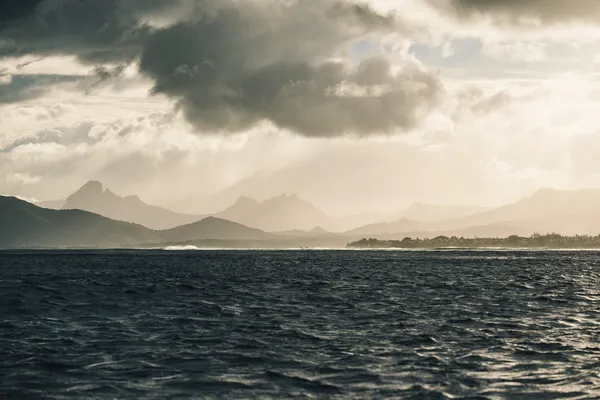
Bonzur! Right now, the weather in Mauritius is hot and supra-humid, with short bursts of torrential rain; one hears 'ki pe dir sa saler la?' as well as ‘enn bon cyclone pu vini’ every day. And though the youth are excited at the idea of missed school days, Alex learned through interviews a few years ago that the older generation is particularly on their guard when cyclones approach, given that many of them experienced Cyclone Carol (1960) and Cyclone Gervaise (1975) – the two most powerful cyclones to have ever struck the island. It’s worth noting, too, that cyclones come with their own psychological and social heritage (such as Touni Minwi, for instance), which are brilliantly explored in a number of academic papers like this one.

News digest
Will Paul Berenger leave the government? We’re being treated to another round of tensions within the ruling coalition. Over the last several months, Berenger has threatened to walk out if the electoral promises the MMM made weren’t upheld, and this week, he has claimed outright that he doesn’t want to stay in the coalition anymore. He is, however, stuck in a difficult situation: the overwhelming majority of MMM members belonging to the Comité Central don’t want to leave the government. This may entail a change of leadership within the MMM and perhaps the creation of a new breakaway party. All eyes are on the MMM on Monday 23rd March, where there may be a declaration as to the party’s future.
The Independence Day celebrations held at the Champ de Mars this year were marked by numerous displays of the Mauritius Police Force, the Special Mobile Forces and other public safety bodies, which took up one hour and forty-five minutes of the two hour and fifteen-minute programme. Though one could hardly call the displays a showcase of Mauritian military might, the heavy emphasis on law and order was perhaps designed to show some kind of readiness, given the strained events happening in the Indian Ocean. The parade, in particular, also highlighted India’s importance to the island: Indian officers marched on the ground, and a helicopter brandished India’s flag in the sky. While the police’s best efforts lay in their creative ‘formation’, the public-at-large loved Move for Art’s thirty-minute show that closed the ceremony.
In more Independence Day news, we were delighted to see that lauded Mauritian writer Nathacha Appanah was made Grand Officer of the Order of the Star and Key of the Indian Ocean, Mauritius’ highest distinction. Other notable names honoured for the National Day Awards include Dr Vikash Tatayah (made Commander of the Star and Key), the excellent conservation director of the Mauritius Wildlife Foundation, and Henri Favory (Member of the Order of the Star and Key), one of the most celebrated figures in Mauritian theatre.
Yet another Mauritian woman was killed by her partner: Yogeshwaree Bhunjun was murdered by her husband, Arvind Ramchurn, who was arrested on the 10th March. Ramchurn paid three men to commit the murder, and Yogeshwaree’s body has not yet been found. This brings the number of femicides committed this year to six. Mauritius still hasn’t been able to make great strides in protecting its women from domestic violence, intimate partner violence, harassment and assault, but we do want to leave you with Judge Mehdi Manrakhan’s landmark judgement delivered on the 10 December 2025: ‘This Court must speak clearly: women in Mauritius are not the property of those who once lived with them; their autonomy is not conditional; and their refusal to submit to control cannot become a death sentence,’ he said, as he gave a life sentence to the man who killed Sheena Buleeram.
In better news, the V-Dem Democracy Report 2026 states that Mauritius is democratising; reports from the same institution had said that our island was rapidly autocratising under the previous government. ‘A welcome and dramatic turnaround is occurring in Mauritius,’ reads this year’s report. ‘While still listed as an autocratizer in last year’s Democracy Report, it now leads the U-turn list in terms of magnitude of improvement. During its autocratization period, the government censored the media, harassed journalists, and was caught with wiretapping, altogether undermining democracy. One of the longest-standing and most enduring democracies in Africa, Mauritius descended to a “grey zone” electoral autocracy in 2023. Yet the 2024 general elections brought a change in government and halted authoritarian transgressions. In 2025, Mauritius regained its standing as an electoral democracy.’
Mauritius on the move
In this edition, we’d like to highlight Mauritius’ efforts concerning smart and sustainable agriculture. For decades, our soils were blasted with record-shattering amounts of herbicides and pesticides. It seems that we’re in an interesting transitional stage: over the past few years, we’ve seen organic farming workshops held by the government and other organisations such as Le Vélo Vert, and witnessed the emergence of companies that are engaged in sustainable agricultural practices like Zardin La Laura, FieldGood and Origin’est. The Food and Agricultural Research and Extension Institute and the Reunionnese Groupe GMD SAS launched a Smart Greenhouse pilot scheme in November 2025 that is well underway: it aims to introduce soilless and vertical farming technologies to farmers, researchers, students, and entrepreneurs. A company we love called JacFruit has been growing organic microgreens and leafy greens indoors, vertically, and in controlled climates for some time now, and their produce is regularly stocked in supermarkets across the island – proving that organic produce is a crucial, and commercially viable, way forward for Mauritian planters.

Diaspora spotlight
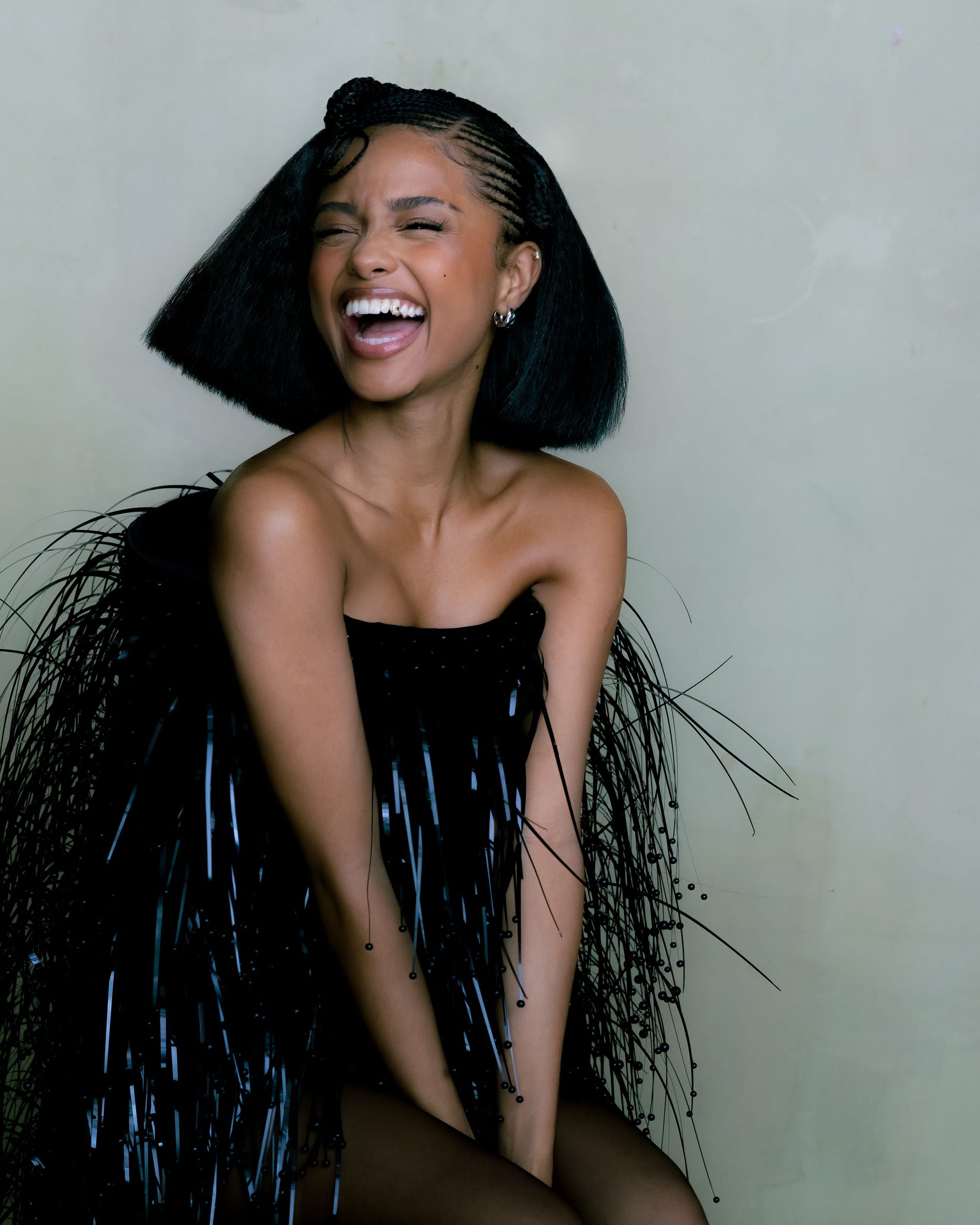
You couldn’t enter a gym, bar or shop in 2023 without hearing Tyla’s hit song Water. Tyla is a South African superstar, with 34 industry awards under her name, two Grammys among them. With Water she became the first South African solo artist in 55 years to enter the US Billboard Hot 100. What you may not know is that she’s also of Mauritian descent: her father, Sherwin Seethal, is Mauritian. Her household was filled with music, melding different South African genres with RnB and pop, which would all later feed into her signature beats. While her parents encouraged her to explore singing early on, they were apparently less-than-enthused when Tyla decided that singing would become her whole career. She was enrolled in a course in mining engineering, and had to beg her parents for one year to try and make it big in music. We sense that there are more than a few diaspora members chuckling at this very on-brand Mauritian-African-Asian style of parenting.
Culture corner
The months leading up to March 12 1968 were mired in violence and bloodshed, and marked by two great forced displacements: the exile of mostly Creole families from Northern Port Louis during the months-long 'racial riots' of 1968, and the expulsion of the Chagossian community from their archipelago between 1967 and 1973. The act of Mauritian independence — the very act of consolidating a nation — unfolded against the backdrop of one ethnic community's mass displacement from the capital, and then from Mauritius itself; and, simultaneously, against the illegal excision of one of Mauritius' own territories, with all the horrors of Chagossian derasinman that followed.
Many Mauritians who watched our flag hoisted for the first time in Port Louis would have felt tense. Their hopes for a peaceful, stable nation rested in this fragile piece of cloth, waving over a capital that had known unprecedented violence – such violence, in fact, that the British Police’s records of the racial riots are kept in Kew Gardens, London, rather than in Mauritius. The subject is still so fraught that school history books won’t write more than a paragraph about the riots. Pieces on the riots published in l’express – in 2018! – went viral, with many Mauritians upset that the ‘bagarres’ were being talked about again.
The riots are, without a doubt, the most traumatic events in Mauritian memory. A few authors have attempted to create timelines of the events, which you can read about here (Alex is loath to include her own work in the Bulletin, but no-one else has translated extracts of Jean-Claude de L’Estrac’s Passions Politiques or has written on the riots in quite some time).
This brings us to the topic of the flag’s colours, which are laden with symbolism. The officially codified meanings – as published in the Legal Supplement to the Government Gazette of Mauritius in 2015, and consolidated in the National Flag Act of 2022 – are as follows: Red represents the struggle for freedom and independence (the bloodshed it took to get to an independent state); Blue represents the Indian Ocean (the 2.3 million km2 representing our ‘exclusive economic zone’); Yellow represents the new light of independence; and Green represents the agriculture (and tropical, year-round flora) of Mauritius. Mauritians have also seen in the colours a representation of the various political, ethnic and religious communities of the island: Red signifies Hinduism, and is also the colour associated with the Labour Party; Blue is the PMSD and represents ‘Catholics’ in general, given the symbolic associations of blue with the Virgin Mary; Yellow, for Sookdeo Bissoondoyal’s Independent Forward Block, but also the Tamil community and Mauritians of Chinese descent; Green is for Comité d’Action Musulman and for the Muslim community. One could argue that the flag was designed to become a great unifier of Mauritian people – even though, visually, the colours of the flag don’t mix.
V.S. Naipaul described Mauritius as an ‘overcrowded barracoon’ in his egregious collection of essays of the same name. Time and time again, economists, journalists and other commentators have shaken their heads and predicted that our island was doomed. Time and time again, we have reinvented ourselves and prospered. The work of our nation, now more than ever in these times of war and fascism, is to continue our ancestral struggle for collective human rights; to cherish our multiculturality and multi-faceted identities; to fight for the complete decolonisation of the Republic, and for the restoration of the Chagossian Archipelago to the Chagossian people.

We’ve set up office hours! A good number of people have contacted us saying they’d like to chat, and we wanted to set up dedicated hours for members of our community. Sign up here for available slots. We can’t wait to speak to you.

Sirandann
From Arnaud Carpooran’s Proverb ek Sirandann Repiblik Moris, we bring you this gem:
Mo ena enn barik ki ena de kalite lapintir, zame lapintir la melanze?
Translated, it means:
I have a barrel that has two types of paint, but none of them ever mix. What am I?
Can you guess what it is? We’ll give you the answer in the next Bulletin.
The Bridge playlist
In this edition, we asked artist Audrey Albert if she had a favourite Chagossian song. She said that it was tricky to choose, but she loves everything produced by Groupe Tanbour Chagos, and is always deeply moved by Mo Ti Ena 13 an. The song is devastating in its lyrics, rhythm and power.
Kreol crossword puzzle
P.S. Know somebody who is missing Moris? Forward this publication to them, and spread the joy!