

Bonzur and welcome to the very first Bridge Bulletin, a publication that has been designed with the hope of suffusing your inboxes with the texture of contemporary Mauritian life. A bi-weekly pulse-check, if you will, on the island’s news, culture and community.
We’ve called this first edition Breaking Surface, after a poem by Mark Nepo that captured a moment of resolve for both of us. It accompanied Yashna as she chose to pursue Bridge Moris full-time, and later resonated with Alex as she, too, committed fully to this social enterprise. In different moments, the poem marked the same decision: to build Bridge Moris with care, conviction, and intention.
For us, the Bulletin is the first foundational bridge we are building: a way to reconnect members of the Mauritian diaspora with the island, while also creating a space that is very much for those at home. Through it, we will also update you on the talent platform that we are working towards launching later in the year to facilitate knowledge transfer and collaboration between Mauritians in the diaspora and Mauritians on the island.
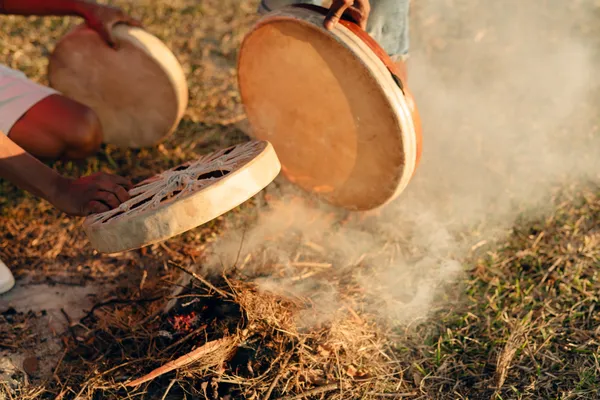
This newsletter wouldn’t have been possible without the contribution of Mauritians on the island – thank you especially to Khatleen Minerve for her photos – and Mauritians of the diaspora, whose feedback ensured that we’d craft the best publication possible.
If you have any additional feedback on the Bridge Bulletin, positive or constructive, please do share it with us using this short feedback form.
This is your space.

News digest
Mauritius is already preparing its response to the escalating war in the Middle East. Mauritians in the Gulf are stranded, but repatriation plans are being developed in coordination with different embassies, and the government has published hotline numbers here to help. As of the time of writing, petrol prices are stable and no emergency load-shedding plans from the CEB have been announced.
All eyes are, once again, on the Chagos archipelago. To summarise latest events pre-war: Trump backtracked on the initial deal to handover the islands; meanwhile, a group of Chagossians led by self-appointed leader Misley Mandarin decided to establish residence on one of the islands, protesting the transfer to Mauritius, in a move greatly supported by the British far-right; the Maldivian President challenged the Mauritian claim to Chagos, asserting that the Maldives has a stronger historical right to the islands, leading Mauritius to suspend all diplomatic ties with the country; ratification of the treaty was apparently paused by the British House of Lords. Now that the Middle East war has begun, there have been critical developments: the British Prime Minister is allowing the base on Diego Garcia to be used for strikes specifically targeting Iranian missile sites – which could mean that the base could be under attack.
Island nations are particularly vulnerable to mosquito- and rat-borne diseases. We’re currently facing outbreaks of chikungunya (117 cases since January 2026) and leptospirosis (nine cases and three deaths since January 2026). A number of campaigns have been broadcast, and for chikungunya new strategies have been implemented: they include a combination of fogging, larviciding and the launch of millions of sterile mosquitoes into the wild, to curb mosquito populations. Alex can personally attest to the fact that the Ministry of Health’s hotline is very efficient. We’re also looking forward to the next wave of chikungunya and leptospirosis vaccines developed abroad.
Accusations of paedophilia in Loreto College Curepipe Junior School have dominated the headlines over the past few weeks. The explosion of the story – as well as the arrest of the culprit, and investigation of the school – may finally catalyse a long-awaited reckoning on paedophilia, harassment and abuse present in schools across the country. Many women online are naming the men who preyed upon them and their classmates, and are questioning the complete lack of action from their schools, and the degree to which other staff members would have known about their colleagues’ behaviour.
This happened in January, but bears repeating in case you missed it: Greenpeace has set up an office in Mauritius called the Greenpeace Africa Foundation, which aims to work alongside Mauritian institutions and communities to protect our marine ecosystems and strengthen enforcement of environmental law. We’re glad to see marine biologist and Mauritian climate activist Shaama Sandooyea at the forefront of their social media campaigns lately.

Diaspora spotlight
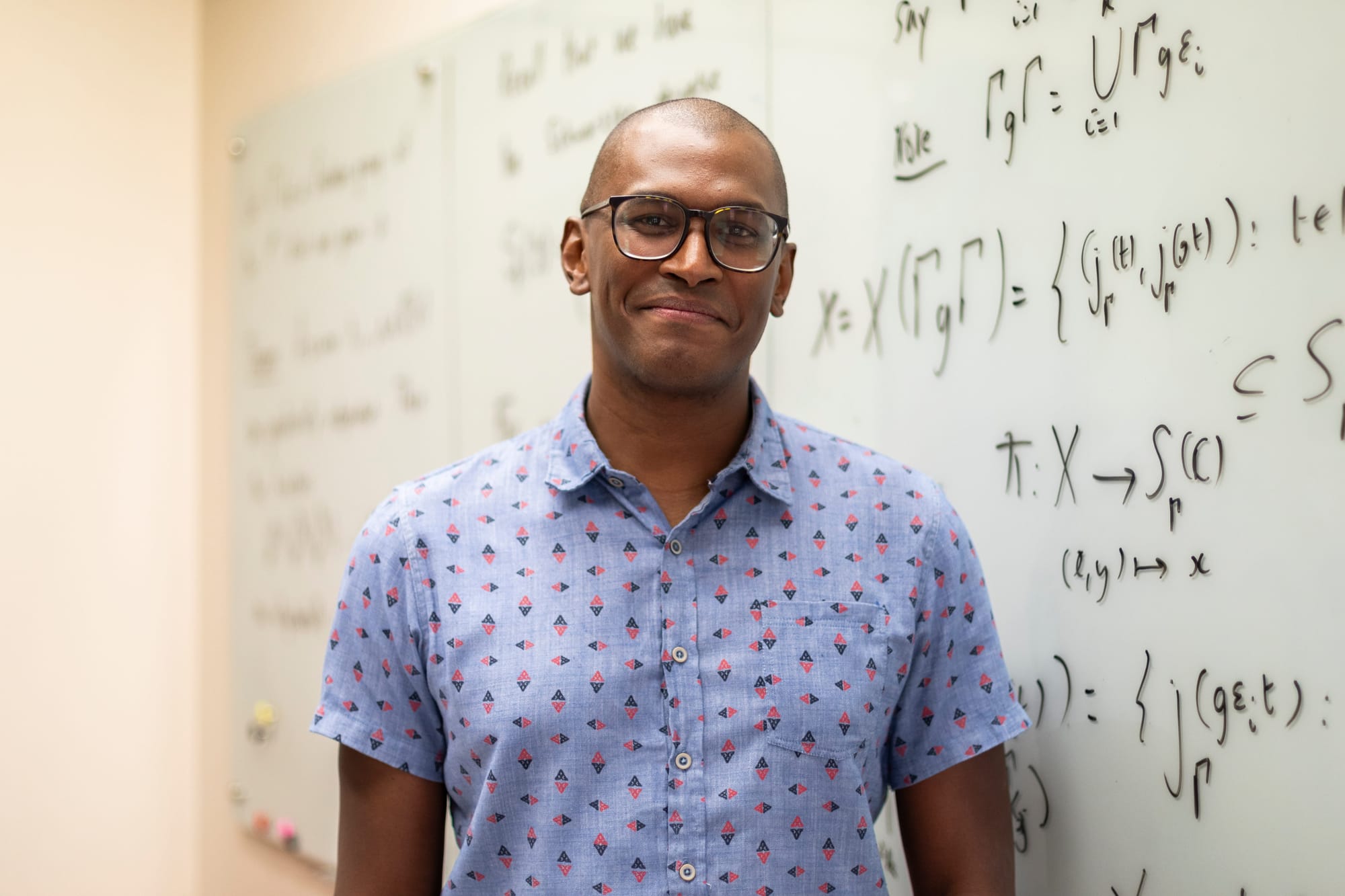
Ronnie Nagloo is an Associate Professor in the Department of Mathematics, Statistics, and Computer Science at the University of Illinois Chicago. He was awarded the prestigious American Mathematical Society’s Centennial Research Fellowship, presented annually to an outstanding early- or mid-career mathematician, in 2023-2024; he was also awarded a National Science Foundation Grant for 2024-2027.
We didn’t regret asking Ronnie what, exactly, his research was about, even though we understood fragments of it – though fragments may be the point. ‘Think of puzzles’, he told us, ‘a pile of puzzle pieces, and you don’t have an image on the box to arrange the pieces. Our work involves learning more and more about how the pieces fit together’. His explanation was so lucid, his manner so calm, that we nodded, believing that we, too, could understand something essential about pure mathematics, if only for a moment. We also learned that mathematicians really love this one kind of blackboard chalk, from Japan, so much so that they hoarded years’ worth of the stuff when they thought the company was going to go bust. Chalk aside, Ronnie combusts stereotypes: he is the calmest academic we have ever met (he says mindfulness helps him manage stress, and recommends it to everyone), and he has track-record brilliance in both sports and schooling.
Ronnie’s father, Jean Claude, was part of Mauritius’ Special Mobile Forces, and the tight-knit family lived in the SMF’s quarters in Vacoas. Jean Claude was also one of the most lauded boxing trainers of his time, coaching the likes of Richarno Colin and Bruno Julie. ‘My dad didn’t finish high school, and he saw all the opportunities he could have gotten had he been able to complete his secondary education. And so for me, when I first began to be interested in sports, it was clear that I would have to be both an athlete and a good student.’
Ronnie excelled as an athlete, moving from regional teams in various sports to competing at the national level in basketball, eventually representing Mauritius at the Jeux des Îles de l’Océan Indien in 2003 (among other honours). Funnily enough, it was a hitch at school that germinated his interest in mathematics. ‘My parents never had to tell me to do my schoolwork; I handled it all quite easily. But when I went to secondary school, mathematics just didn’t stick. My mother knew there was a problem because I’d never struggled with any of my subjects until that point. So she found a tuition teacher for me, Mr. Indiren, who taught me maths in a way that I really enjoyed: he taught me how to think. We examined mathematical problems together, so I’d understand the theory behind what we were solving.’ The opposite of learning by rote, which is still the de facto teaching method in Mauritian schools. Though Ronnie quickly regained his excellent standing at school, he was aware that the system was unjust. ‘When I grew up, if you didn’t do well in CPE, your whole life was over. And we are so competitive, among ourselves. We leave so many people behind. One of my dreams for Mauritius is to demonstrate that mathematics isn’t reserved for certain brains and backgrounds, that maths is accessible, and that students shouldn’t drop the subject too early if they’re struggling.’
After secondary school, Ronnie studied mathematics at the University of Mauritius. He worked for a while in Mauritius and Australia to self-fund his Master’s in Pure Mathematics at Imperial College London, and was then granted a scholarship for his PhD at Leeds. After completing his PhD, he received offers for post-doctoral research in North America. ‘I was married by then, and had already – in my life at that point –emigrated twice. I wanted to settle down, grow roots. I was afraid that I’d have to start all over again in America. The postdoc wasn’t a guarantee of a permanent position, either. But my wife and my parents convinced me to emigrate one more time.’ He landed at CUNY as a visiting assistant professor, and by the time he became Associate Professor in 2020, he’d achieved a major career milestone, more significant to him than the grants he’d received: he had a paper published in the Annals of Mathematics, widely regarded as one of the leading research journals in mathematics; he currently has a second paper under review there and says he never would have imagined—even in his wildest dreams—being in that position (which we thought was so wonderfully nerdy). The research program underlying this work led to his appointment at the University of Illinois Chicago, where he is currently based.
In Chicago, Ronnie teaches, plays basketball every once in a while, and cooks a lot. ‘I have two children, and I want them to experience everything Mauritian. I make as many Mauritian dishes as I can, and my children love it. We listen to music.’ A particular hit in the Nagloo household is Ronnie’s biryani ‘It’s my mum’s recipe. It requires a trip to Mauritius and a bag full of Mauritian spices.’ He also meditates for his mental health, and says it helps him when imposter syndrome rears its ugly head. ‘If you are someone from a minority background in science, you find it difficult to reconcile achievements with luck. So that’s been one of the hardest things to deal with. I follow a lot of Buddhist principles, so I manage my stress with mindfulness and meditation, and recommend them to everyone.’
We asked him how he felt, as a Mauritian in America. Did he feel like the US was his home? His answer was unexpected and thought-provoking. ‘I’ll always be Mauritian, and my island is my home, but an important part of emigration is jumping into the new country with both feet. Truly embrace the new culture you’re living in, take ownership of your new bearings. Call it a new home. You have two homes now.’

We wanted to showcase this fantastic event happening on March 12th 2026 – Independence day! – at New York University. Co-organized by the Calamegs Reading Group and NYC-based Mauritian artists Sondy Lu, Jaina Teeluck, and Dylan Castanette, ‘Roots, Renewal and Resistance’ will screen a trio of documentaries from the island that explore cultural identity, justice and collective memory in Mauritius and the Chagos Islands. Sea Walkers is an intimate oral history film of Chagossian memory, displacement, and the enduring search for identity and justice, Pie Dan Lo is a hand-drawn tribute to Mauritian unity and grassroots resilience in the wake of the 2020 MV Wakashio oil spill, and Bann Vag Laliberte offers a poetic portrait of ancestral resistance and modern freedom set in Rivière Noire. There’ll be conversation, great food and music, too.
RSVP here, and if you’d like to organize a screening in your city, get in touch and we’ll facilitate introductions!

The Bridge playlist
For this first edition, we wanted to showcase a piece that’s as fresh and directional as we hope to be. We love this set by GREG at the Boiler Room SYSTEM: MAURITIUS event in 2024. Don’t just listen, give it a watch: GREG’s music was so electrifying that, halfway through the set, the stage gave way under the weight of everyone dancing on it. The joy present in those 12 minutes is an incredible thing to behold: there’s a Mauritian flag hoisted at the back, Greg’s mother and grandmother are right there with him on the deck, and everyone is having the absolute time of their lives. GREG is a Port-Louis raised, French-based artist who regularly releases on Boukan Records.
Crossword puzzle
P.S. Know somebody who is missing Moris? Forward this publication to them, and spread the joy!